Transaction monitoring: catching fraud inside an alert budget
A fraud model judged the way a monitoring team actually uses it. Built for Standard Chartered's PS-II internship.
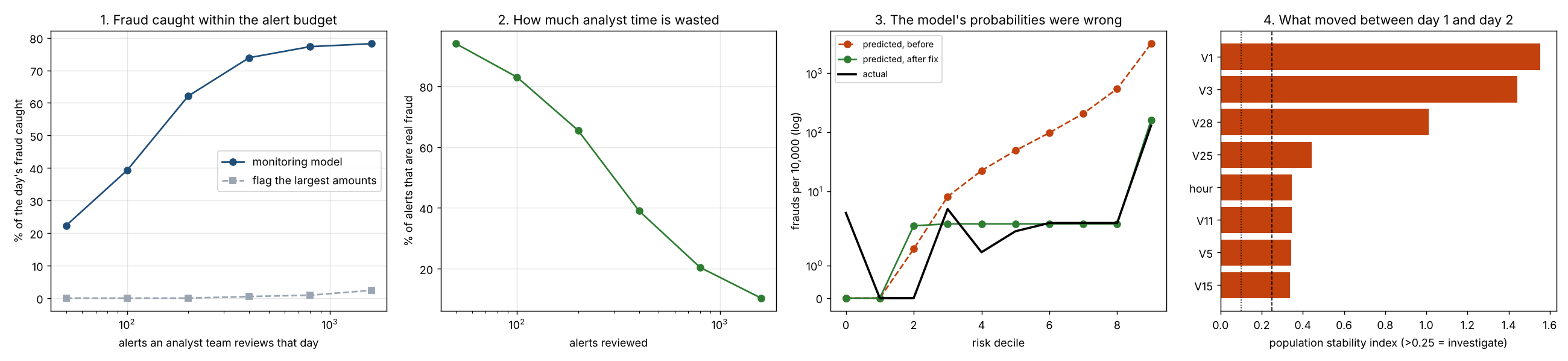
47 of 50alerts are real fraud when the team reviews only the top 50 of the day
62%of the day's fraud caught within 200 alerts, out of 140,021 transactions
0frauds the 'flag the largest amounts' rule finds in its first 200 alerts
284,807real transactions; frauds are 0.17% of them
Try it: how big should the alert budget be?
Measured on the second day, which the model never saw. Review cost is an input, not data.
Model vs the rule a bank starts with
| Alerts reviewed | Frauds caught | Alerts that are real fraud | Share of the day's fraud | "Largest amounts" rule |
|---|---|---|---|---|
| 50 | 47 | 94% | 22% | 0 |
| 100 | 83 | 83% | 39% | 0 |
| 200 | 131 | 66% | 62% | 0 |
| 400 | 156 | 39% | 74% | 1 |
| 800 | 163 | 20% | 77% | 2 |
| 1600 | 165 | 10% | 78% | 5 |
Validation checks
Built by Pavitra Seth (BITS Pilani). Public data used as a stand-in; not affiliated with the company. Code and method: see the repository README.